Excretion in Humans Notes
Cambridge IGCSE Biology: Revision notes
Key facts
- The lungs excrete carbon dioxide; the kidneys excrete urea, excess water and excess ions in urine.
- The urinary system is kidneys, ureters, bladder and urethra.
- The kidney has an outer cortex (ultrafiltration) and an inner medulla (water reabsorption).
- In the nephron, ultrafiltration removes small molecules from the blood, then selective reabsorption returns all glucose, some ions and most water.
- Excess amino acids are deaminated in the liver; the toxic ammonia is made into urea.
Excretory organs
The lungs excrete carbon dioxide, and the kidneys filter the blood to make urine, which passes to the bladder and out through the urethra.
Link each part of the urinary system to its function: kidneys filter, ureters carry urine, the bladder stores it and the urethra carries it out of the body.
- 1
Kidneys
Filter the blood and make urine
- 2
Ureters
Carry urine to the bladder
- 3
Bladder
Stores urine
- 4
Urethra
Carries urine out of the body
Which organ stores urine?
Kidney structure
The outer cortex is where blood is filtered; the inner medulla is where water is reabsorbed.
The cortex is the outer layer. It contains the first part of the nephrons, where ultrafiltration happens. The medulla is the inner region with cone-shaped structures. It contains loops of Henle and collecting ducts, where water reabsorption is regulated. Do not mix the regions up.
| Cortex | Medulla | |
|---|---|---|
| Position | Outer layer | Inner region |
| Function | Contains the first part of nephrons: ultrafiltration | Loops of Henle and collecting ducts: water reabsorption |
Cortex
- Position:
- Outer layer
- Function:
- Contains the first part of nephrons: ultrafiltration
Medulla
- Position:
- Inner region
- Function:
- Loops of Henle and collecting ducts: water reabsorption
Where does ultrafiltration take place?
The nephron
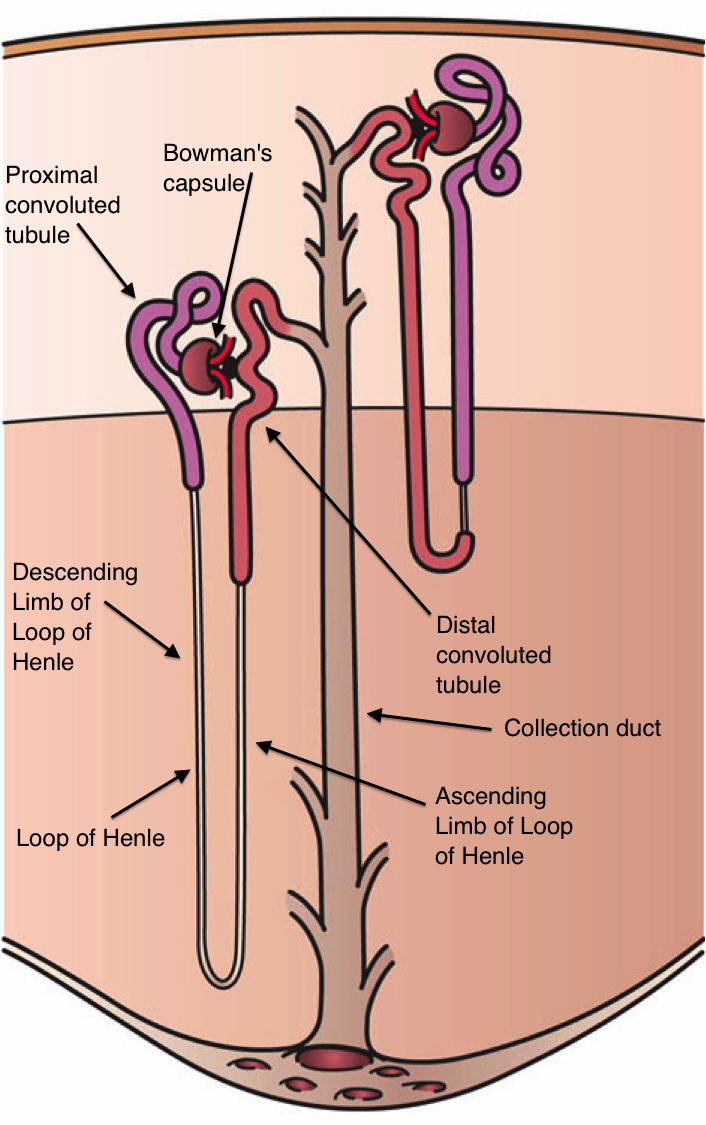
The nephron filters small molecules out of the blood, then takes back everything useful.
In ultrafiltration the glomerulus forces small molecules into Bowman's capsule. In selective reabsorption all the glucose, some ions and most of the water return to the blood. What remains (urea, excess water and ions) is urine. Large proteins are not filtered.
- 1
Ultrafiltration
Glomerulus forces small molecules into Bowman's capsule
- 2
Selective reabsorption
All glucose, some ions and most water return to the blood
- 3
Urine formed
Urea, excess water and excess ions remain
- 4
Collecting duct
Urine passes to the ureter
| Filtered? | Reabsorbed? | In urine? | |
|---|---|---|---|
| Glucose | Yes | All of it | No |
| Urea | Yes | No | Yes |
| Water | Yes | Most of it | Excess only |
| Large proteins | No | Not applicable | No |
Filtered?
- Glucose:
- Yes
- Urea:
- Yes
- Water:
- Yes
- Large proteins:
- No
Reabsorbed?
- Glucose:
- All of it
- Urea:
- No
- Water:
- Most of it
- Large proteins:
- Not applicable
In urine?
- Glucose:
- No
- Urea:
- Yes
- Water:
- Excess only
- Large proteins:
- No
Glucose is found in a patient's urine. Why is this abnormal?
Urea
The liver breaks down excess amino acids and makes the toxic ammonia into urea.
The body cannot store excess amino acids. In the liver the nitrogen-containing part is removed (deamination), forming ammonia, which is very toxic. The liver converts it to urea, which is carried in the blood to the kidneys and excreted. The remainder of the amino acid is used in respiration.
- 1
Excess amino acids
Not needed for protein synthesis
- 2
Deamination
Nitrogen-containing group removed
- 3
Ammonia
Highly toxic
- 4
Urea
Less toxic; carried to the kidneys and excreted
What happens to excess amino acids in the liver?
Why excretion matters
Waste products are toxic or upset the balance of the body, so excretion keeps the internal environment stable.
Urea is toxic to cells, especially the nervous system. Carbon dioxide would lower blood pH and disrupt enzymes. Excess water and ions must go so that cells do not burst or shrivel. Link excretion to a stable internal environment for enzymes and cells.
- 1
Metabolism makes wastes
Urea, carbon dioxide, excess water and ions
- 2
Wastes build up
Urea is toxic; CO2 lowers blood pH; water and ions upset cells
- 3
Excretion removes them
Kidneys remove urea, water and ions; lungs remove CO2
- 4
Internal environment stays stable
Enzymes and cells keep working
| Urea | Carbon dioxide | Excess water and ions | |
|---|---|---|---|
| Excreted by | Kidneys | Lungs | Kidneys |
| Why it must be removed | Toxic to cells | Lowers blood pH and disrupts enzymes | Stop cells bursting or shrivelling |
Urea
- Excreted by:
- Kidneys
- Why it must be removed:
- Toxic to cells
Carbon dioxide
- Excreted by:
- Lungs
- Why it must be removed:
- Lowers blood pH and disrupts enzymes
Excess water and ions
- Excreted by:
- Kidneys
- Why it must be removed:
- Stop cells bursting or shrivelling
What can happen if the kidneys fail to excrete urea?
Try an exam question
Describe how urea is formed in the body and how it is removed.
[4 marks]
- [1]Excess amino acids are broken down in the liver.
- [1]The nitrogen-containing part is removed (deamination), forming ammonia.
- [1]Ammonia is converted into urea.
- [1]Urea is carried in the blood to the kidneys and removed in urine.
That's the notes covered.
Carry on to the next subtopic.