Levels of Organisation Notes
Edexcel IGCSE Biology: Revision notes
Key facts
- The order from smallest to largest: organelle, cell, tissue, organ, organ system, organism.
- A tissue is a group of similar cells with a shared function.
- An organ is made of two or more different tissues.
- An organ system is a group of organs working together.
The hierarchy
Each level is built from the level below: organelles, cells, tissues, organs, organ systems, organisms.
Give them in the correct order. Examiners award one mark per correctly placed term.
- 1
Organelles
- 2
Cells
- 3
Tissues
- 4
Organs
- 5
Systems
Which level comes between cell and organ?
Organelles and cells
An organelle is a specialised structure inside a cell. A cell is the smallest unit that can carry out all processes of life.
A cell is built from many organelles working together, such as the nucleus and mitochondria.
The nucleus is an example of an...
Tissues
A tissue is a group of similar cells that work together to do a shared job.
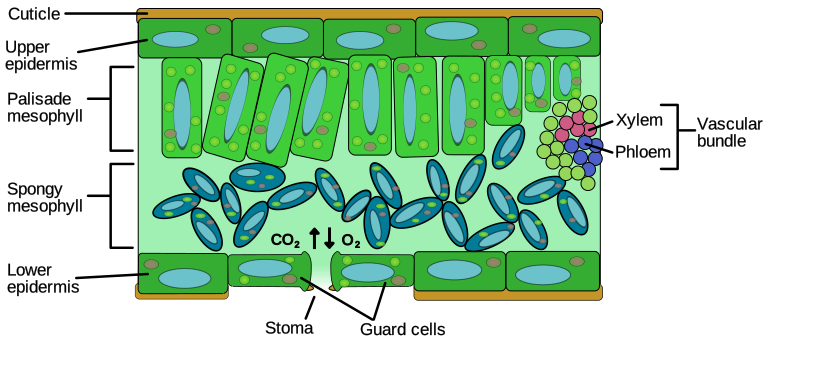
Animal tissues: muscle tissue contracts to cause movement and epithelial tissue lines surfaces such as the gut. Plant tissues: xylem transports water and mineral ions and phloem transports sucrose and amino acids.
Animal tissues
- Muscle: contracts
- Epithelial: lines surfaces
Plant tissues
- Xylem: water and mineral ions
- Phloem: sucrose and amino acids
Which tissue transports sucrose?
Organs and organ systems
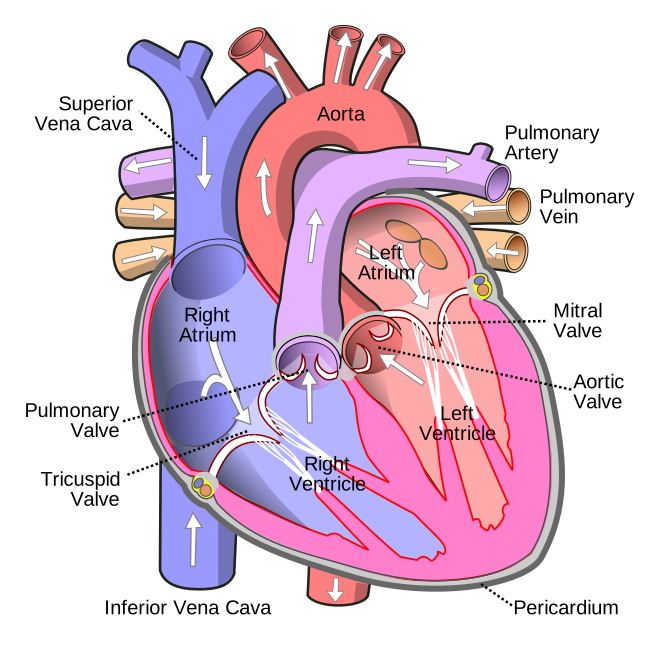
An organ is made of different tissues. An organ system is several organs working together.
The heart has muscle tissue to contract, connective tissue to hold it together and nervous tissue to coordinate contraction. The digestive system includes the mouth, oesophagus, stomach, small and large intestine and pancreas. The leaf is a plant organ with epidermal, palisade, spongy mesophyll, xylem and phloem tissue.
Tissue
- Muscle tissue
Organ
- Heart
Organ system
- Circulatory system
The stomach and small intestine are parts of the...
Try an exam question
Describe what is meant by an organ, using the heart as an example.
[3 marks]
- [1]An organ is made of two or more different tissues working together
- [1]The heart contains muscle tissue, which contracts
- [1]It also contains connective tissue (holds it together) or nervous tissue (coordinates contraction)
That's the notes covered.
Carry on to the next subtopic.