Photosynthesis Notes
Oxford AQA IGCSE Biology: Revision notes
Key facts
- Photosynthesis: carbon dioxide + water → glucose + oxygen, using light absorbed by chlorophyll in chloroplasts.
- Carbon dioxide enters leaves by diffusion through the stomata; water is absorbed by the roots.
- The rate is limited by light, carbon dioxide or temperature: whichever is in shortest supply.
- Greenhouses raise these factors, but only if the extra yield is worth the cost.
- Glucose is used for respiration, starch, fat or oil, cellulose and proteins.
The photosynthesis equation
Plants and algae use light energy to make glucose from carbon dioxide and water, releasing oxygen as a by-product.
Photosynthesis needs light, absorbed by chlorophyll in chloroplasts. In leaves, the palisade mesophyll does most of it.
Light is the energy source, written above the arrow, not a reactant.
- Word equationcarbon dioxide + water → glucose + oxygen
- Symbol equation
- 1
Light energy
absorbed by chlorophyll in chloroplasts
- 2
Carbon dioxide and water
carbon dioxide from the air, water from the soil
- 3
Glucose and oxygen
glucose is the food; oxygen is released
Which substance is a by-product of photosynthesis?
Carbon dioxide and water
Carbon dioxide diffuses into the leaf through the stomata; roots absorb water and mineral ions.
Root hairs increase the surface area of the roots for absorbing water and mineral ions. The flattened shape of leaves gives a large surface area to volume ratio, and air spaces in the spongy mesophyll help gases diffuse.
Stomata let carbon dioxide in and oxygen out. They close if the plant loses water faster than the roots replace it, to prevent wilting.
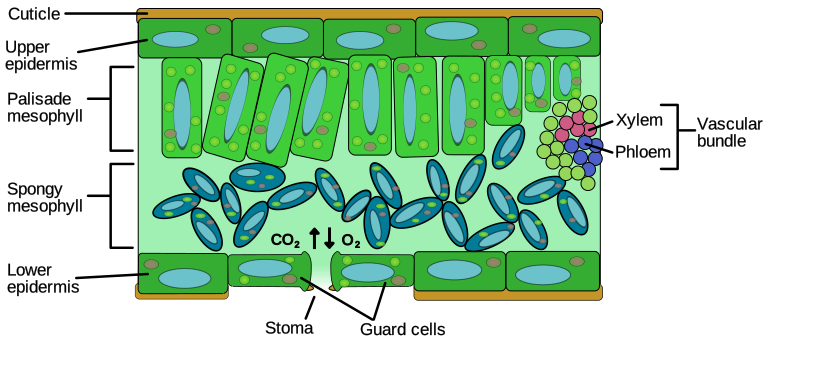
- 1
Air
contains carbon dioxide
- 2
Stomata
carbon dioxide diffuses in
- 3
Air spaces
gases diffuse to the cells in the spongy mesophyll
- 4
Palisade cells
carbon dioxide is used in photosynthesis
How does carbon dioxide enter a leaf?
Limiting factors
The rate is limited by the factor in shortest supply: light, carbon dioxide or temperature. Raising any other factor will not help.
These factors interact, and any one may be the limiting factor at a given time.
On a graph, the rate rises as the limiting factor increases, then levels off when another factor becomes limiting. When a graph levels off, the factor on the x-axis is no longer limiting.
Light
- Less energy absorbed by chlorophyll
Carbon dioxide
- Less of this reactant available
Temperature
- Enzymes work slowly at low temperature
A graph levels off as light increases. Which is true?
Greenhouses
Growers raise temperature, carbon dioxide and light to speed photosynthesis, but the extra crop must pay for the cost.
Raising the rate of photosynthesis increases growth. Each change has a cost, so economics matter: the extra glucose, and so the extra crop, must be worth more than the heating, gas and electricity.
Raising a factor that is not limiting wastes money.
Temperature
- Heaters keep the greenhouse warm
Carbon dioxide
- Add it by burning a fuel or using a generator
Light intensity
- Artificial lighting extends the hours of light and brightens dull days
Heating a greenhouse gives no extra growth. The best explanation is
Uses of glucose
Glucose is used for respiration, or converted into starch, fat or oil, cellulose and proteins.
Plants use glucose as a source of energy, or convert it into larger molecules. Insoluble starch is the storage form, and being insoluble it does not affect the water balance of cells.
To make proteins, plants also need nitrate ions from the soil, which provide the nitrogen that glucose lacks.
- 1
Respiration
Releases energy for life processes
- 2
Starch
Insoluble, so stored without affecting water balance
- 3
Fat or oil
Also used for storage
- 4
Cellulose
Strengthens the cell wall
- 5
Proteins
Glucose plus nitrate ions from the soil
| Product | Purpose | |
|---|---|---|
| Respiration | Energy released | Life processes |
| Starch | Insoluble starch | Storage |
| Fat or oil | Fat or oil | Storage |
| Cellulose | Cellulose | Strengthens the cell wall |
| Proteins | Proteins | Needs nitrate ions from the soil |
Product
- Respiration:
- Energy released
- Starch:
- Insoluble starch
- Fat or oil:
- Fat or oil
- Cellulose:
- Cellulose
- Proteins:
- Proteins
Purpose
- Respiration:
- Life processes
- Starch:
- Storage
- Fat or oil:
- Storage
- Cellulose:
- Strengthens the cell wall
- Proteins:
- Needs nitrate ions from the soil
Which ions do plants need to make proteins?
Investigating the rate
Count the oxygen bubbles from pondweed in a set time, changing one factor and keeping the others constant.
Place pondweed in water in a beaker with a lamp at a measured distance. Count bubbles of oxygen in a set time, or collect and measure the gas. Repeat and calculate a mean.
Change one variable only, and use the same piece of pondweed. A heat shield or water bath stops the lamp changing the temperature.
- 1
Set up
pondweed in water, lamp at a measured distance
- 2
Measure
count oxygen bubbles in a set time
- 3
Change one variable
then repeat the measurement
- 4
Calculate a mean
from the repeats
Light intensity
- Move the lamp closer or further away
Carbon dioxide
- Add different amounts of sodium hydrogencarbonate
Temperature
- Use a water bath at different temperatures
Moving the lamp closer changes the
Try an exam question
Explain how a grower could increase the rate of photosynthesis in a greenhouse, and why this might not be worthwhile.
[4 marks]
- [1]Raise a limiting factor: heat, add carbon dioxide or provide extra light.
- [1]More of the limiting factor means a faster rate of photosynthesis, so more glucose and growth.
- [1]Only raising the limiting factor increases the rate.
- [1]The extra crop must be worth more than the cost of heating, gas or electricity.
That's the notes covered.
Carry on to the next subtopic.