The human nervous system Notes
Oxford AQA IGCSE Biology: Revision notes
Key facts
- The CNS (brain and spinal cord) coordinates responses; the PNS (nerves) connects it to the body.
- A sensory neurone carries impulses to the CNS, a relay neurone connects within it, and a motor neurone carries them to an effector.
- At a synapse, a chemical neurotransmitter carries the signal across the gap, so impulses go one way only.
- A reflex arc is: stimulus, receptor, sensory neurone, relay neurone, motor neurone, effector, response.
- The lens changes shape to focus on near or distant objects; the retina holds the light receptors.
- Short sight is corrected with a concave lens; long sight with a convex lens.
Brain and spinal cord
The brain and spinal cord form the central nervous system (CNS); nerves running to the rest of the body form the peripheral nervous system (PNS).
The CNS processes information and coordinates responses. The PNS is made of sensory and motor nerves that connect the CNS to receptors and effectors.
Each part of the brain has its own job, shown below.
- 1
Receptor
Detects a stimulus
- 2
Sensory neurone
PNS: carries impulses to the CNS
- 3
Brain or spinal cord
CNS: processes and coordinates
- 4
Motor neurone
PNS: carries impulses away
- 5
Effector
Muscle or gland responds
CNS
- Brain and spinal cord
- Processes information
- Coordinates responses
PNS
- Sensory and motor nerves
- Connect CNS to the body
- Carry signals both ways
Cerebral cortex
- Voluntary actions
- Memory, language, consciousness
Cerebellum
- Coordinates muscles
- Balance and posture
Medulla
- Heart rate
- Breathing rate
Hypothalamus
- Body temperature
- Water content
Which part of the brain controls breathing rate?
Neurones and synapses
Neurones carry electrical impulses, but at a synapse the signal is passed on chemically, which is why it can only travel in one direction.
There are three types of neurone: sensory, relay and motor. Each has a cell body with a nucleus and a long axon.
A synapse is the gap between two neurones. Impulses cannot jump it, so a chemical neurotransmitter crosses instead.
Sensory
- Receptor to CNS
- Carries impulse in
Relay
- Inside the CNS
- Links sensory to motor
Motor
- CNS to effector
- Muscle or gland responds
- 1
Impulse arrives
At the end of the first neurone
- 2
Release
Neurotransmitter enters the gap
- 3
Binding
It attaches to receptors on the next neurone
- 4
New impulse
Starts in the next neurone
Why can impulses only travel one way across a synapse?
Reflex arcs
A reflex arc is the pathway of a fast, automatic response that does not wait for the brain to decide.
A reflex arc protects the body from danger: the response is rapid, automatic and does not involve conscious thought. Examples are pulling a hand from a flame and the pupil narrowing in bright light.
The impulse passes through the spinal cord, not the brain.
- 1
Stimulus
Detected by a receptor
- 2
Sensory neurone
Impulse to the spinal cord
- 3
Relay neurone
Passes the signal on
- 4
Motor neurone
Impulse to the effector
- 5
Effector
Muscle or gland gives the response
Worked example
A hand touches a hot plate. Describe the pathway.
- 1
Heat is the stimulus; receptors in the skin detect it.
- 2
A sensory neurone carries the impulse to the spinal cord.
- 3
A relay neurone passes it to a motor neurone.
- 4
The motor neurone carries it to the arm muscle (effector), which contracts.
Which neurone carries the impulse to the effector?
The eye and focusing
The eye focuses light on the retina by changing the shape of the lens, controlled by the ciliary muscles and suspensory ligaments.
Light is refracted by the cornea and lens onto the retina, which has rods (dim light) and cones (colour). The optic nerve carries impulses to the brain.
Accommodation is the lens changing shape to focus. The iris makes the pupil smaller in bright light and larger in dim light.
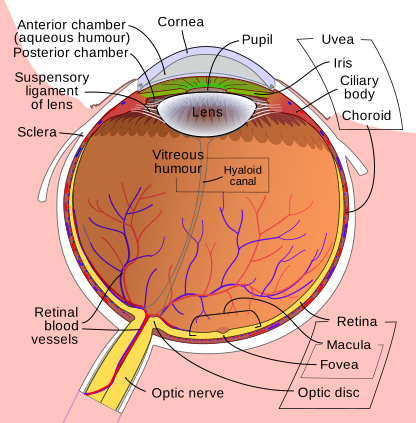
| Near object | Distant object | |
|---|---|---|
| Ciliary muscles | Contract | Relax |
| Suspensory ligaments | Slacken | Pulled tight |
| Lens | Thicker, refracts more | Thinner, refracts less |
Near object
- Ciliary muscles:
- Contract
- Suspensory ligaments:
- Slacken
- Lens:
- Thicker, refracts more
Distant object
- Ciliary muscles:
- Relax
- Suspensory ligaments:
- Pulled tight
- Lens:
- Thinner, refracts less
Cornea
- Refracts light
Iris
- Controls pupil size
Lens
- Focuses light on retina
Retina
- Rods and cones; optic nerve to brain
To focus on a near object, the ciliary muscles...
Defects of vision
Short sight and long sight happen when light is not focused on the retina, and a lens in front of the eye corrects it.
In short-sightedness, distant objects are blurred because light focuses in front of the retina. A concave (diverging) lens spreads the rays out.
In long-sightedness, near objects are blurred because light focuses behind the retina. A convex (converging) lens brings the rays together.
| Short sight | Long sight | |
|---|---|---|
| Cause | Light focuses in front of retina | Light focuses behind retina |
| Problem | Distant objects blurred | Near objects blurred |
| Correction | Concave lens | Convex lens |
Short sight
- Cause:
- Light focuses in front of retina
- Problem:
- Distant objects blurred
- Correction:
- Concave lens
Long sight
- Cause:
- Light focuses behind retina
- Problem:
- Near objects blurred
- Correction:
- Convex lens
A person cannot see near objects clearly. They need a...
Try an exam question
Describe how the eye focuses on a near object.
[4 marks]
- [1]Ciliary muscles contract.
- [1]Suspensory ligaments slacken.
- [1]The lens becomes thicker (more curved).
- [1]So light is refracted more and focused on the retina.
That's the notes covered.
Carry on to the next subtopic.