Principles of Organisation Notes
AQA GCSE Biology: Revision notes
Key facts
- Organisms are organised as cells → tissues → organs → organ systems.
- A tissue is a group of similar cells; an organ is several different tissues working together.
- The digestive system is an organ system: several organs work together to digest and absorb food.
- Enzymes are protein catalysts; each fits one substrate at its active site (lock and key).
- Extreme temperature or pH denatures an enzyme by changing the shape of its active site.
Levels of organisation
Cells make tissues, tissues make organs and organs make organ systems, each level built from the one below.
Multicellular organisms are built in a hierarchy from the smallest working unit to the whole organism.
- Cells are the basic building blocks.
- A tissue is a group of cells with a similar structure and function.
- An organ is made of different tissues performing a specific function.
- An organ system is a group of organs working together for one function of the whole organism.
- 1
Cells
the basic building blocks of all organisms
- 2
Tissues
a group of cells with a similar structure and function, working together
- 3
Organs
different tissues performing specific functions
- 4
Organ systems
groups of organs working together for the whole organism
Which statement correctly describes an organ?
The digestive system
The digestive system is an organ system: several organs, each made of different tissues, work together to digest and absorb food.
The digestive system includes the stomach, small intestine, large intestine, liver and pancreas.
Each organ contains different tissues doing different jobs, such as muscular tissue that churns or moves food, glandular tissue that makes digestive juices, and epithelial tissue that covers surfaces. All contribute to one overall function: digestion and absorption of food.
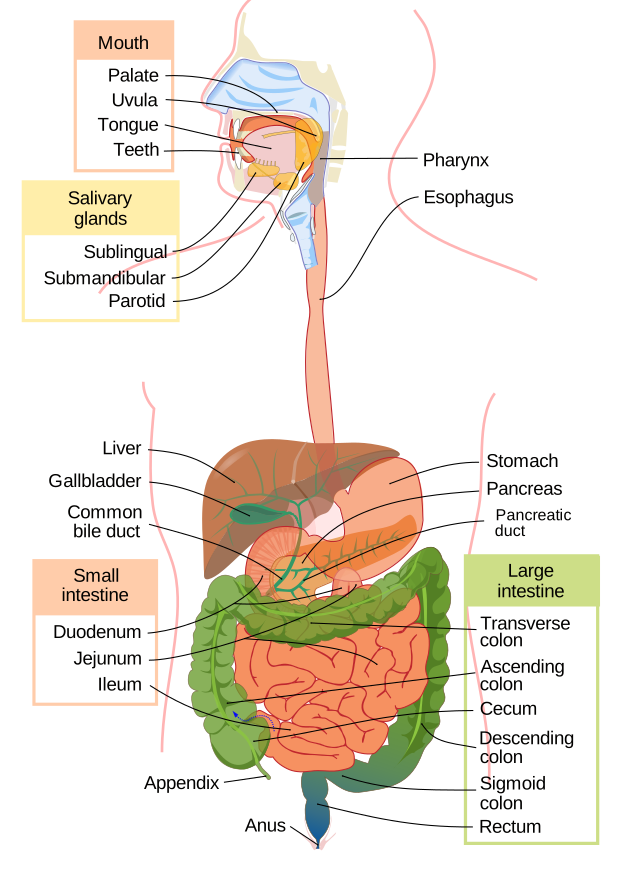
Stomach
- Muscular tissue churns the food
- Glandular tissue makes acid and protease
- Epithelial tissue covers the surfaces
Small intestine
- Glandular tissue makes enzymes
- Epithelial tissue absorbs digested food
- Muscular tissue moves food along
Why is the digestive system called an organ system?
Enzymes
Enzymes are protein catalysts; each fits one substrate at its active site, and its activity depends on temperature and pH.
Enzymes are biological catalysts made of protein. Each catalyses a specific reaction because of the shape of its active site.
The lock and key model: only a substrate with a complementary shape (the key) fits the active site (the lock).
Activity rises with temperature up to an optimum, then falls sharply as the enzyme is denatured, because the active site changes shape. Each enzyme also has an optimum pH.
What happens when an enzyme denatures?
Other organ systems
Yes: the heart is an organ in the circulatory system, which carries blood around the body.
The same hierarchy applies across the body. The heart is an organ made largely of muscle tissue that pumps blood as part of the circulatory system.
This is a double circulatory system: the right side pumps blood to the lungs, and the left side pumps blood around the rest of the body.
Individual organs, each built from several tissues, combine into an organ system that carries out one overall process for the whole organism.
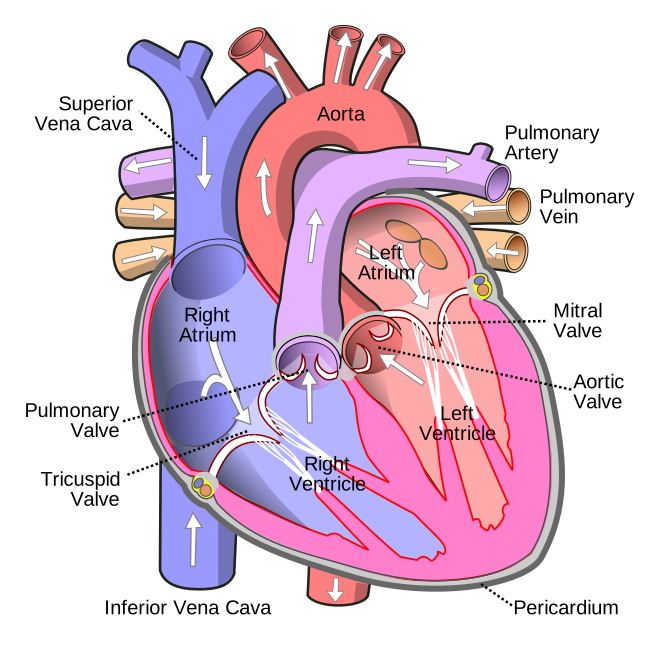
In a double circulatory system, where does the right side of the heart pump blood?
Try an exam question
Explain why the stomach is an organ and not a tissue.
[3 marks]
- [1]A tissue is a group of similar cells with the same function.
- [1]The stomach is made of several different tissues.
- [1]For example muscular tissue, glandular tissue and epithelial tissue working together to digest food.
That's the notes covered.
Carry on to the next subtopic.