Cell Division Notes
Edexcel GCSE Biology: Revision notes
Key facts
- The cell cycle: interphase (DNA replicates), mitosis, then cytokinesis.
- Mitosis has four stages: prophase, metaphase, anaphase, telophase.
- It makes two genetically identical diploid daughter cells.
- It is needed for growth, repair and asexual reproduction.
- Cancer is uncontrolled cell division, forming a tumour.
The cell cycle
The cell cycle has three stages: interphase, mitosis and cytokinesis.
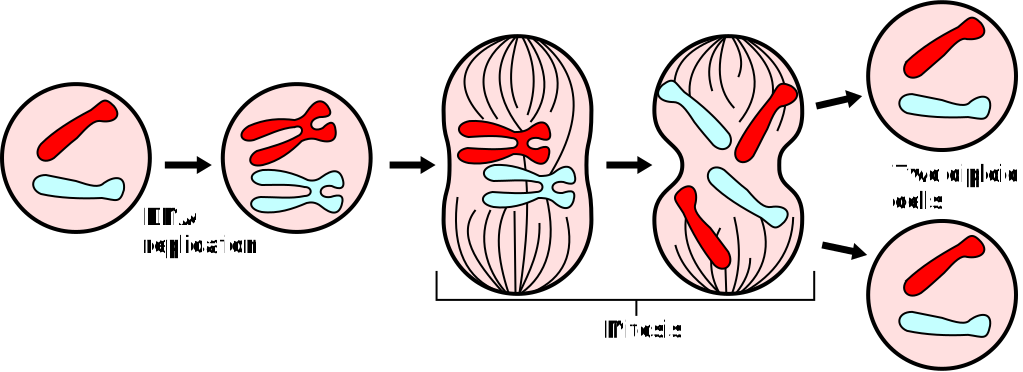
The cell cycle is the series of stages between one division and the next. In interphase the cell grows, replicates its DNA (each chromosome becomes two sister chromatids) and makes new organelles. In mitosis the nucleus divides; in cytokinesis the cytoplasm and membrane divide.
DNA replication happens in interphase, before mitosis.
- 1
Interphase
The cell grows, replicates DNA and produces new organelles.
- 2
Mitosis
The nucleus divides.
- 3
Cytokinesis
The cytoplasm and membrane divide, forming two daughter cells.
Then back to step 1
When is DNA replicated?
Stages of mitosis
Mitosis divides the nucleus in four stages, then cytokinesis splits the cytoplasm.
In prophase, chromosomes condense and the nuclear envelope breaks down. In metaphase they line up at the equator. In anaphase sister chromatids are pulled to opposite poles. In telophase the nuclear envelope re-forms around each set. Cytokinesis then splits the cytoplasm into two daughter cells.
- 1
Prophase
Chromosomes condense; nuclear envelope breaks down.
- 2
Metaphase
Chromosomes line up at the equator.
- 3
Anaphase
Sister chromatids are pulled to opposite poles.
- 4
Telophase
Nuclear envelope re-forms around each set.
- 5
Cytokinesis
The cytoplasm splits into two daughter cells.
In which stage are sister chromatids pulled apart?
What mitosis produces
Mitosis produces two genetically identical diploid daughter cells.
Each daughter cell has the same chromosome set as the parent: it is diploid. Do not confuse this with meiosis, which produces genetically different haploid gametes.
| Mitosis | Meiosis | |
|---|---|---|
| Cells produced | Two daughter cells | Gametes |
| Chromosomes | Diploid: same set as the parent | Haploid |
| Genetically | Identical | Different |
Mitosis
- Cells produced:
- Two daughter cells
- Chromosomes:
- Diploid: same set as the parent
- Genetically:
- Identical
Meiosis
- Cells produced:
- Gametes
- Chromosomes:
- Haploid
- Genetically:
- Different
How do the daughter cells of mitosis compare with the parent cell?
Why mitosis matters
Mitosis is essential for growth, repair and asexual reproduction.
A cut heals because mitosis produces new skin cells identical to the surrounding tissue.
- 1
Parent cell
copies its DNA
- 2
Mitosis
divides into two identical cells
- 3
Growth and repair
more cells, or replacement of damaged ones
- 4
Asexual reproduction
identical offspring
Growth
- Increases cell number
Repair
- Replaces damaged cells
Asexual reproduction
- Produces genetically identical offspring
A cut skin heals. Which process makes the new cells?
Cancer
Cancer is caused by changes in cells that lead to uncontrolled cell division.
Changes in cells cause uncontrolled mitosis. The cells form a mass of abnormal cells called a tumour. Always link cancer to uncontrolled cell division.
- 1
Cell changes
Changes in a cell affect its control of division.
- 2
Uncontrolled mitosis
The cell divides again and again.
- 3
Tumour
A mass of abnormal cells forms.
What causes cancer?
Try an exam question
Describe what happens to the chromosomes and the nucleus during mitosis.
[4 marks]
- [1]Chromosomes condense and the nuclear envelope breaks down.
- [1]Chromosomes line up at the equator.
- [1]Sister chromatids are pulled to opposite poles.
- [1]The nuclear envelope re-forms around each set of chromosomes.
That's the notes covered.
Carry on to the next subtopic.