Cell Structure Notes
Cambridge IGCSE Biology: Revision notes
Key facts
- Animal cells have a nucleus, cytoplasm, cell membrane, mitochondria and ribosomes; plant cells also have a cell wall, a large vacuole and chloroplasts.
- Bacterial cells have no nucleus: their DNA is circular and free in the cytoplasm, and they often have plasmids.
- Specialised cells have structures adapted to their function.
- Organisation: cell, tissue, organ, organ system, organism.
- New cells are produced by division of existing cells: mitosis for growth and repair, meiosis for gametes.
Animal cells
Each structure in a cell has a job: the nucleus controls, mitochondria release energy and ribosomes make proteins.
Describe the function of each structure, not just its name.
- Nucleus: contains DNA and controls the cell's activities.
- Cytoplasm: where metabolic reactions happen.
- Cell membrane: partially permeable barrier controlling what enters and leaves.
- Mitochondria: site of aerobic respiration.
- Ribosomes: site of protein synthesis.
Which structure is the site of protein synthesis?
Plant cells
Plant cells have a cell wall, a large permanent vacuole and chloroplasts that animal cells lack.
The cell wall is made of cellulose, outside the membrane, and supports the cell. The large vacuole stores water and keeps the cell firm. Chloroplasts contain chlorophyll for photosynthesis. When comparing, state what is present and what is absent: 'plant cells have a cell wall, animal cells do not'.
| Animal cell | Plant cell | |
|---|---|---|
| Cell wall | Absent | Present (cellulose) |
| Vacuole | Small and temporary | Large and permanent |
| Chloroplasts | Absent | Present |
Animal cell
- Cell wall:
- Absent
- Vacuole:
- Small and temporary
- Chloroplasts:
- Absent
Plant cell
- Cell wall:
- Present (cellulose)
- Vacuole:
- Large and permanent
- Chloroplasts:
- Present
Which structure is present in plant cells but not animal cells?
Bacterial cells
A bacterial cell has no nucleus: its DNA is free in the cytoplasm.
Bacteria are prokaryotes. Their circular DNA lies free in the cytoplasm, not enclosed by a membrane, and they often carry small rings of DNA called plasmids. They have a cell wall (peptidoglycan), cell membrane and ribosomes but no chloroplasts or mitochondria. The defining difference from plant and animal cells is the lack of a membrane-bound nucleus.
| Bacterial cell | Plant cell | |
|---|---|---|
| DNA | Circular, free in cytoplasm | Inside a nucleus |
| Cell wall | Peptidoglycan | Cellulose |
| Chloroplasts | Absent | Present |
| Plasmids | Often present | Absent |
Bacterial cell
- DNA:
- Circular, free in cytoplasm
- Cell wall:
- Peptidoglycan
- Chloroplasts:
- Absent
- Plasmids:
- Often present
Plant cell
- DNA:
- Inside a nucleus
- Cell wall:
- Cellulose
- Chloroplasts:
- Present
- Plasmids:
- Absent
What is the defining difference between a bacterial cell and a plant cell?
Specialised cells
Specialised cells have structures that suit their function, and good answers link each adaptation to its purpose.
Link every adaptation to its function using 'because' or 'so that'. For example, ciliated cells have many mitochondria because movement needs energy, and root hair cells are long to increase surface area for faster water absorption. Listing features without a reason earns fewer marks.
- 1
Feature
For example, many mitochondria
- 2
Reason
because movement needs energy
- 3
Function
so cilia can move mucus along
| Ciliated cell | Root hair cell | Palisade mesophyll | Neurone | |
|---|---|---|---|---|
| Adaptation | Cilia; many mitochondria | Long extension; large vacuole | Packed with chloroplasts | Long axon and dendrites |
| Function | Move mucus and bacteria out of the lungs | Absorbs water and ions from the soil | Photosynthesis | Transmits impulses over long distances |
Ciliated cell
- Adaptation:
- Cilia; many mitochondria
- Function:
- Move mucus and bacteria out of the lungs
Root hair cell
- Adaptation:
- Long extension; large vacuole
- Function:
- Absorbs water and ions from the soil
Palisade mesophyll
- Adaptation:
- Packed with chloroplasts
- Function:
- Photosynthesis
Neurone
- Adaptation:
- Long axon and dendrites
- Function:
- Transmits impulses over long distances
| Red blood cell | Sperm cell | Egg cell | |
|---|---|---|---|
| Adaptation | No nucleus; biconcave; haemoglobin | Flagellum; many mitochondria | Large; food stores; haploid nucleus |
| Function | Transports oxygen | Swims to and fertilises the egg | Provides nutrients and genetic material for a new organism |
Red blood cell
- Adaptation:
- No nucleus; biconcave; haemoglobin
- Function:
- Transports oxygen
Sperm cell
- Adaptation:
- Flagellum; many mitochondria
- Function:
- Swims to and fertilises the egg
Egg cell
- Adaptation:
- Large; food stores; haploid nucleus
- Function:
- Provides nutrients and genetic material for a new organism
Why do ciliated cells have many mitochondria?
Organisation
Similar cells form tissues, tissues form organs, organs form organ systems, and the systems make up the organism.
Always state the hierarchy with examples. The heart is an organ made of cardiac muscle tissue, nervous tissue and epithelial tissue. It is part of the circulatory system. Never say 'system of cells' when you mean tissue.
- 1
Cell
Smallest living unit
- 2
Tissue
Similar cells
- 3
Organ
Different tissues
- 4
Organ system
Organs together
- 5
Organism
Whole individual
| Plant example | Human example | |
|---|---|---|
| Cell | Palisade mesophyll cell | Ciliated cell |
| Tissue | Palisade tissue | Ciliated epithelial tissue |
| Organ | Leaf | Trachea |
| Organ system | Shoot system | Respiratory system |
| Organism | Plant | Human |
Plant example
- Cell:
- Palisade mesophyll cell
- Tissue:
- Palisade tissue
- Organ:
- Leaf
- Organ system:
- Shoot system
- Organism:
- Plant
Human example
- Cell:
- Ciliated cell
- Tissue:
- Ciliated epithelial tissue
- Organ:
- Trachea
- Organ system:
- Respiratory system
- Organism:
- Human
Which is an organ?
Cell division
New cells are produced by the division of existing cells.
Use the specification phrase 'new cells are produced by division of existing cells'. Mitosis lets an organism grow from a zygote and replaces damaged or worn-out cells, such as skin. Meiosis makes gametes. Without cell division, organisms could not grow or repair themselves.
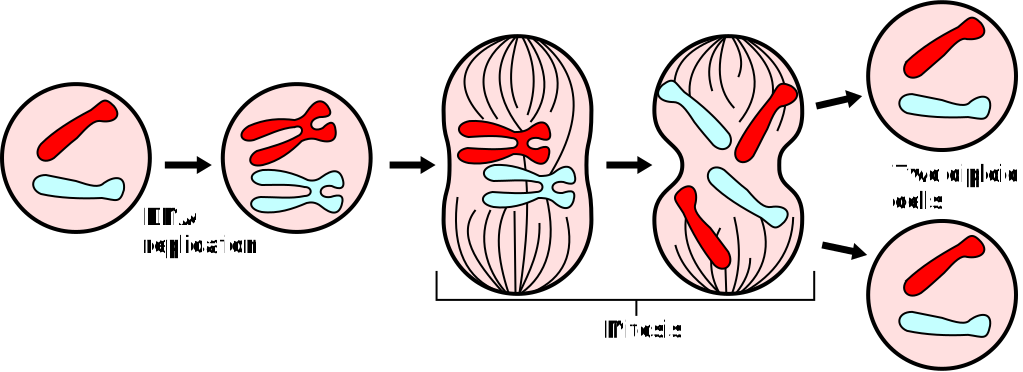
| Mitosis | Meiosis | |
|---|---|---|
| Where | Growth and repair in body cells | Making gametes |
| Result | Two identical daughter cells | Cells with half the chromosome number |
Mitosis
- Where:
- Growth and repair in body cells
- Result:
- Two identical daughter cells
Meiosis
- Where:
- Making gametes
- Result:
- Cells with half the chromosome number
Which type of cell division produces gametes?
Try an exam question
Describe two ways in which a root hair cell is adapted to its function.
[4 marks]
- [1]The root hair cell has a long extension (root hair).
- [1]This increases the surface area for absorption of water and ions.
- [1]It has a large vacuole.
- [1]This helps water to move into the cell by osmosis.
That's the notes covered.
Carry on to the next subtopic.