Gas Exchange
Studying this course? Keep your progress in one place.
Key facts
- Alveoli have a large surface area, walls one cell thick, a good blood supply, a moist lining and good ventilation.
- Oxygen diffuses from the alveoli into the blood; carbon dioxide diffuses the other way.
- Diffusion is faster with a larger surface area, a steeper gradient and a shorter distance.
- Rate of diffusion is proportional to surface area × concentration difference ÷ thickness.
- Rate of diffusion
Adaptations of the alveoli
Alveoli give a large surface area, a short distance and a steep gradient for diffusion.
Alveoli are adapted for gas exchange. Oxygen diffuses from the alveoli into the blood, and carbon dioxide diffuses from the blood into the alveoli. Millions of alveoli together create a large total surface area. The lining is moist so gases dissolve.
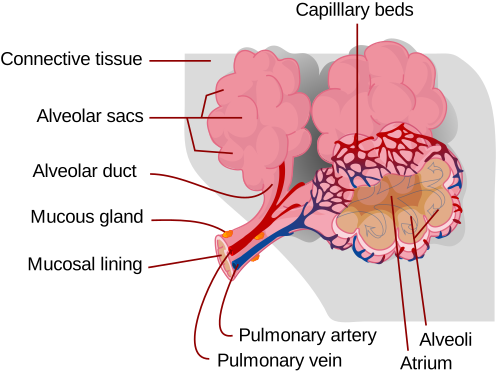
Large surface area
- Millions of alveoli together
Short distance
- Walls one cell thick
Steep gradient
- Good blood supply
- Good ventilation
Moist lining
- Gases dissolve
Which adaptation makes the diffusion distance short?
What affects the rate of diffusion
A larger surface area, a steeper concentration gradient and a shorter distance all speed up diffusion.
Three factors increase the rate of diffusion: larger surface area, steeper concentration gradient and shorter diffusion distance.
| Surface area | Concentration gradient | Diffusion distance | |
|---|---|---|---|
| Change | Larger | Steeper | Shorter |
| Effect on rate | Faster | Faster | Faster |
Surface area
- Change:
- Larger
- Effect on rate:
- Faster
Concentration gradient
- Change:
- Steeper
- Effect on rate:
- Faster
Diffusion distance
- Change:
- Shorter
- Effect on rate:
- Faster
Which change would slow diffusion?
Fick's law
Rate of diffusion is proportional to surface area times concentration difference, divided by membrane thickness.
The rate depends on all three factors together, so doubling the surface area doubles the rate, and doubling the thickness halves it.
- Rate of diffusion
Worked example
Surface area is 6 mm², concentration difference is 10 and thickness is 3. Find the rate (proportional value). What happens if thickness doubles?
- 1
Rate ∝ (6 × 10) ÷ 3.
- 2
Rate ∝ 60 ÷ 3 = 20.
- 3
Doubling thickness to 6 gives (6 × 10) ÷ 6 = 10.
The surface area doubles and nothing else changes. What happens to the rate?
Try an exam question
Explain how the structure of the alveoli makes gas exchange efficient.
[4 marks]
- [1]A large total surface area because there are millions of alveoli.
- [1]Walls one cell thick give a short diffusion distance.
- [1]A good blood supply keeps a steep concentration gradient.
- [1]Good ventilation (and a moist lining) helps oxygen and carbon dioxide diffuse.
That's the notes covered.
Carry on to the next subtopic.
Try a question
Which structural feature of alveoli increases their total surface area for gas exchange in the lungs?
1 mark, marked against the mark scheme
Which structural feature of alveoli increases their total surface area for gas exchange in the lungs?
1 mark, marked against the mark scheme