Plant cell structure
Studying this course? Keep your progress in one place.
Key facts
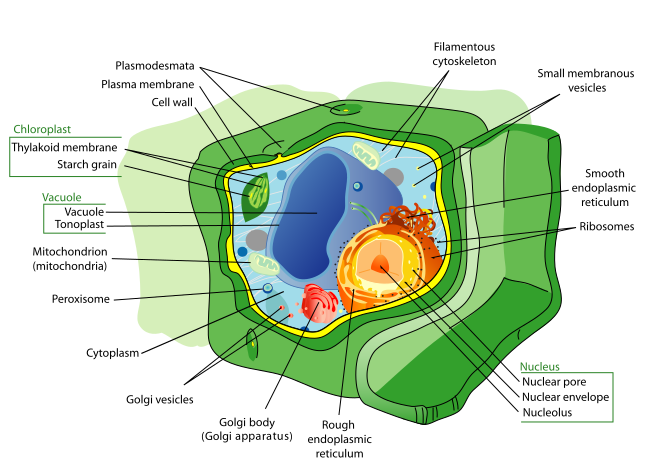
- The cell wall is cellulose, gives strength and prevents bursting; the middle lamella is pectin cementing cells together.
- Plasmodesmata link the cytoplasm of adjacent cells through pits in the wall.
- Chloroplasts carry out photosynthesis; amyloplasts store starch.
- The large permanent vacuole with its tonoplast stores sap and gives turgor.
- Plant cells have a wall, large vacuole and chloroplasts; animal cells do not.
Cell wall and middle lamella
The cellulose cell wall gives strength and shape, and the pectin middle lamella cements neighbouring cells together.
The cell wall surrounds the plasma membrane. It is made mainly of cellulose microfibrils with great tensile strength. It supports the cell and resists expansion when water enters by osmosis, so a turgid cell does not burst. The wall is freely permeable.
The middle lamella is a layer of pectin between neighbouring cell walls that cements the cells together.
Which substance forms the middle lamella?
Plasmodesmata and pits
Plasmodesmata are channels of cytoplasm through the walls, concentrated in pits.
Plasmodesmata are narrow channels of cytoplasm, lined by plasma membrane, that pass through cell walls and link adjacent cells. Substances and signals move through them by diffusion: the symplast pathway.
Pits are thin regions where the wall is not thickened. Plasmodesmata are concentrated in pits, making transport between neighbouring cells easier.
- 1
Substance in the cytoplasm of one cell
moves by diffusion
- 2
Passes through a plasmodesma in a pit
a channel lined by plasma membrane through the wall
- 3
Enters the cytoplasm of the adjacent cell
without crossing the cell wall
Plasmodesmata
- Channels of cytoplasm
- Link adjacent cells
- Symplast pathway
Pits
- Thin areas of wall
- Contain many plasmodesmata
What is the symplast pathway?
Chloroplasts
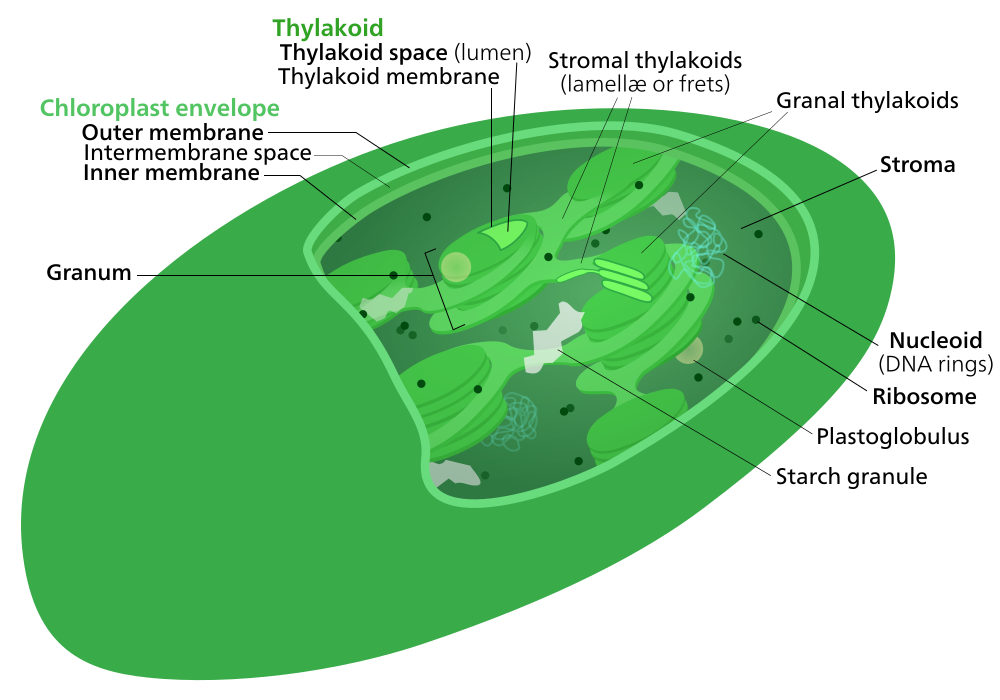
Chloroplasts have a double membrane, thylakoid stacks (grana) and stroma, and carry out photosynthesis.
Chloroplasts are the site of photosynthesis. Each has a double membrane (envelope).
Inside are stacks of flattened membrane sacs, thylakoids, forming grana. Their membranes contain chlorophyll and absorb light for the light-dependent reaction.
The fluid stroma holds enzymes for the light-independent reaction, small circular DNA, 70S ribosomes and sometimes starch grains.
Envelope
- Double membrane
- Surrounds the chloroplast
Thylakoids (grana)
- Stacked sacs with chlorophyll
- Light-dependent reaction
Stroma
- Enzymes, DNA, 70S ribosomes
- Light-independent reaction
Where in a chloroplast does the light-dependent reaction take place?
Amyloplasts
Amyloplasts store starch in an insoluble, compact form.
Amyloplasts are organelles that store starch. They have a double membrane but no thylakoids or chlorophyll. They are found in storage tissues such as potato tubers and seeds and stain blue-black with iodine.
Starch is a good store because it is insoluble, so does not affect water potential, and it is large and compact, so cannot diffuse out.
- 1
Chloroplast
makes glucose by photosynthesis
- 2
Glucose converted to starch
insoluble, so no effect on water potential
- 3
Amyloplast
stores the starch in storage tissue, such as a potato tuber
Chloroplast
- Thylakoids and chlorophyll
- Photosynthesis
Amyloplast
- No thylakoids or chlorophyll
- Stores starch
Why is starch a good storage molecule?
Vacuole and tonoplast
The large permanent vacuole stores cell sap and its water gives turgor pressure that supports the cell.
A mature plant cell has a large permanent vacuole filled with cell sap, a solution of sugars, ions, pigments and waste.
It is surrounded by a single membrane, the tonoplast, which controls what enters and leaves.
The vacuole stores water and solutes. Its water gives turgor pressure, which keeps the cell firm and supports non-woody plants.
- 1
Water enters the vacuole
by osmosis
- 2
Vacuole swells
pushing the cytoplasm against the cell wall
- 3
Turgor pressure rises
the cell becomes firm and supports the plant
Then back to step 1
- Vacuole water= turgor pressure = firm cell
What is the membrane around the vacuole called?
Plant and animal cells
Plant cells have a cellulose wall, a large vacuole, chloroplasts and plasmodesmata; animal cells do not.
Both are eukaryotic, with a nucleus, mitochondria, ribosomes, ER, Golgi apparatus and plasma membrane.
In electron micrographs: the wall is a thick layer outside the plasma membrane; the vacuole is a very large single-membrane sac; a chloroplast has a double membrane and thylakoid stacks; an amyloplast has a double membrane and large pale starch grains but no thylakoids.
| Plant cell | Animal cell | |
|---|---|---|
| Cell wall | Cellulose cell wall | None |
| Vacuole | Large permanent vacuole | Small temporary vacuoles |
| Chloroplasts | In some cells | None |
| Plasmodesmata and pits | Present | Absent |
| Energy store | Starch | Glycogen |
Plant cell
- Cell wall:
- Cellulose cell wall
- Vacuole:
- Large permanent vacuole
- Chloroplasts:
- In some cells
- Plasmodesmata and pits:
- Present
- Energy store:
- Starch
Animal cell
- Cell wall:
- None
- Vacuole:
- Small temporary vacuoles
- Chloroplasts:
- None
- Plasmodesmata and pits:
- Absent
- Energy store:
- Glycogen
Which of these is found in a plant cell but not an animal cell?
Try an exam question
Describe the structure of a chloroplast and explain how it is adapted for photosynthesis.
[5 marks]
- [1]Surrounded by a double membrane (envelope).
- [1]Thylakoids are stacked into grana, giving a large surface area.
- [1]Thylakoid membranes contain chlorophyll to absorb light for the light-dependent reaction.
- [1]The stroma contains the enzymes for the light-independent reaction.
- [1]Contains DNA and 70S ribosomes so it can make some of its own proteins.
That's the notes covered.
Carry on to the next subtopic.
Try a question
What is the function of the tonoplast?
1 mark, marked against the mark scheme
What is the function of the tonoplast?
1 mark, marked against the mark scheme