Eukaryotic cell ultrastructure
Studying this course? Keep your progress in one place.
Key facts
- All cells have a cell surface membrane, cytoplasm, DNA and ribosomes.
- The nucleus controls the cell; the nucleolus makes rRNA and ribosomal subunits.
- Ribosomes make polypeptides; rER folds them; the Golgi apparatus modifies and packages them.
- Mitochondria make ATP; lysosomes hold hydrolytic enzymes.
- Identify organelles in electron micrographs from their shape and membranes.
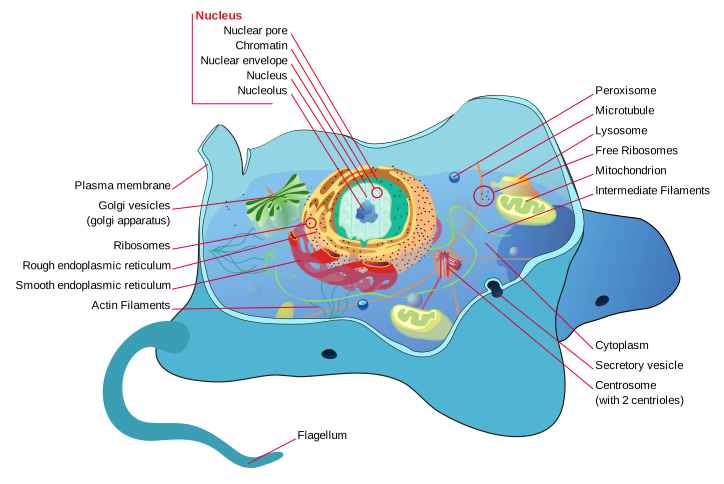
Cells and their organisation
Cells with the same function form tissues, tissues form organs and organs form organ systems.
All cells share a cell surface membrane, cytoplasm, DNA and ribosomes.
In a multicellular organism, similar cells form a tissue, tissues form an organ (the liver) and organs form an organ system (the digestive system). Eukaryotic cells have a nucleus and other membrane-bound organelles. The structure seen with an electron microscope is the ultrastructure.
- 1
Cell
specialised for one function
- 2
Tissue
similar cells working together
- 3
Organ
several tissues, e.g. the liver
- 4
Organ system
organs together, e.g. digestive system
What is a tissue?
Nucleus, nucleolus and ribosomes
The nucleus holds the DNA and controls the cell; ribosomes make the polypeptides.
The nucleus has a double membrane, the nuclear envelope, with nuclear pores. It contains DNA and controls which proteins are made. mRNA leaves through the pores.
The nucleolus makes ribosomal RNA and assembles ribosomal subunits.
Ribosomes have no membrane and are the site of protein synthesis (translation), free in the cytoplasm or on the rough ER.
Nucleus
- Double membrane with pores
- Holds DNA, controls the cell
Nucleolus
- Dark region inside nucleus
- Makes rRNA and ribosomal subunits
Ribosome
- No membrane
- Makes polypeptides
Which structure makes ribosomal subunits?
ER, Golgi apparatus and lysosomes
The rER folds polypeptides, the sER makes lipids, the Golgi modifies and packages proteins and lysosomes digest waste.
Rough ER (rER) has ribosomes on its sacs. Polypeptides enter its lumen, are folded and move in vesicles.
Smooth ER (sER) has no ribosomes. It makes lipids and is involved in detoxification.
The Golgi apparatus is a stack of flattened sacs that modifies and packages proteins into vesicles and forms lysosomes.
Lysosomes have a single membrane and hydrolytic enzymes that digest worn-out organelles and bacteria.
Rough ER
- Flattened sacs with ribosomes
- Folds and transports polypeptides
Smooth ER
- Tubules, no ribosomes
- Makes lipids; detoxification
Golgi apparatus
- Stack of flattened sacs
- Modifies, packages; forms lysosomes
Lysosome
- Single membrane
- Hydrolytic enzymes
Which organelle has ribosomes on its surface?
Mitochondria and centrioles
Mitochondria make ATP by aerobic respiration; centrioles help form the spindle.
Mitochondria have a double membrane. The inner membrane is folded into cristae, giving a large surface area for aerobic respiration, which makes ATP. The fluid inside is the matrix. Cells with a high demand for ATP, such as liver cells, have many.
Centrioles are found in animal cells in pairs. Each is a hollow cylinder of microtubules and helps form the spindle in cell division.
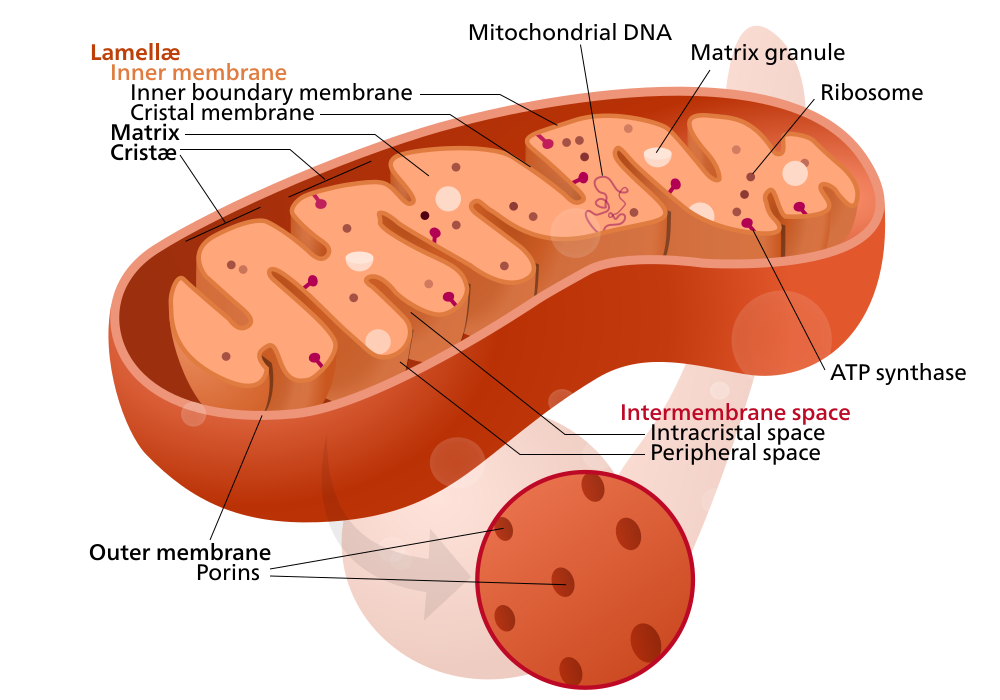
Mitochondrion
- Double membrane
- Cristae and matrix
- Makes ATP
Centriole
- Hollow cylinder of microtubules
- Forms the spindle
Why do the cristae increase the rate of ATP production?
Recognising organelles in micrographs
Look at shape and membranes, then name the organelle from its features.
Use shape and membranes.
- Nucleus: large and round, double membrane with pores, dark nucleolus.
- Mitochondrion: oval, double membrane, inner folds.
- rER: flattened sacs with dark dots.
- sER: tubules with no dots.
- Golgi: stack of curved sacs with vesicles.
- Lysosome: small, round, single membrane.
Nucleus
- Large, round
- Double membrane, pores
Mitochondrion
- Oval or rod
- Inner folds
rER
- Flattened sacs
- Dark dots
Golgi
- Curved stack
- Vesicles at edges
An organelle has a double membrane with a folded inner membrane. What is it?
Making and exporting a protein
The nucleus, rER, Golgi apparatus and cell surface membrane work in sequence, powered by ATP from mitochondria.
The rER and Golgi apparatus work together to make and export proteins such as digestive enzymes.
An enzyme released this way is an extracellular enzyme. Each step needs ATP from mitochondria.
- 1
Transcription
mRNA leaves the nucleus through a nuclear pore
- 2
Translation on the rER
the polypeptide enters the lumen and is folded
- 3
Transport vesicles
bud off the rER and fuse with the Golgi
- 4
Golgi modifies and packages
into secretory vesicles
- 5
Exocytosis
vesicle fuses with the cell surface membrane
Which organelle packages proteins into secretory vesicles?
Try an exam question
Describe the roles of the rough endoplasmic reticulum and the Golgi apparatus in the production and secretion of a digestive enzyme.
[5 marks]
- [1]Ribosomes on the rough ER make the polypeptide.
- [1]The polypeptide enters the lumen of the rER and is folded.
- [1]It is transported in vesicles to the Golgi apparatus.
- [1]The Golgi apparatus modifies the protein and packages it into secretory vesicles.
- [1]The vesicle fuses with the cell surface membrane and the enzyme is released (exocytosis).
That's the notes covered.
Carry on to the next subtopic.
Try a question
Which structure is the site of synthesis of the polypeptide chains of the enzyme?
1 mark, marked against the mark scheme
Which structure is the site of synthesis of the polypeptide chains of the enzyme?
1 mark, marked against the mark scheme